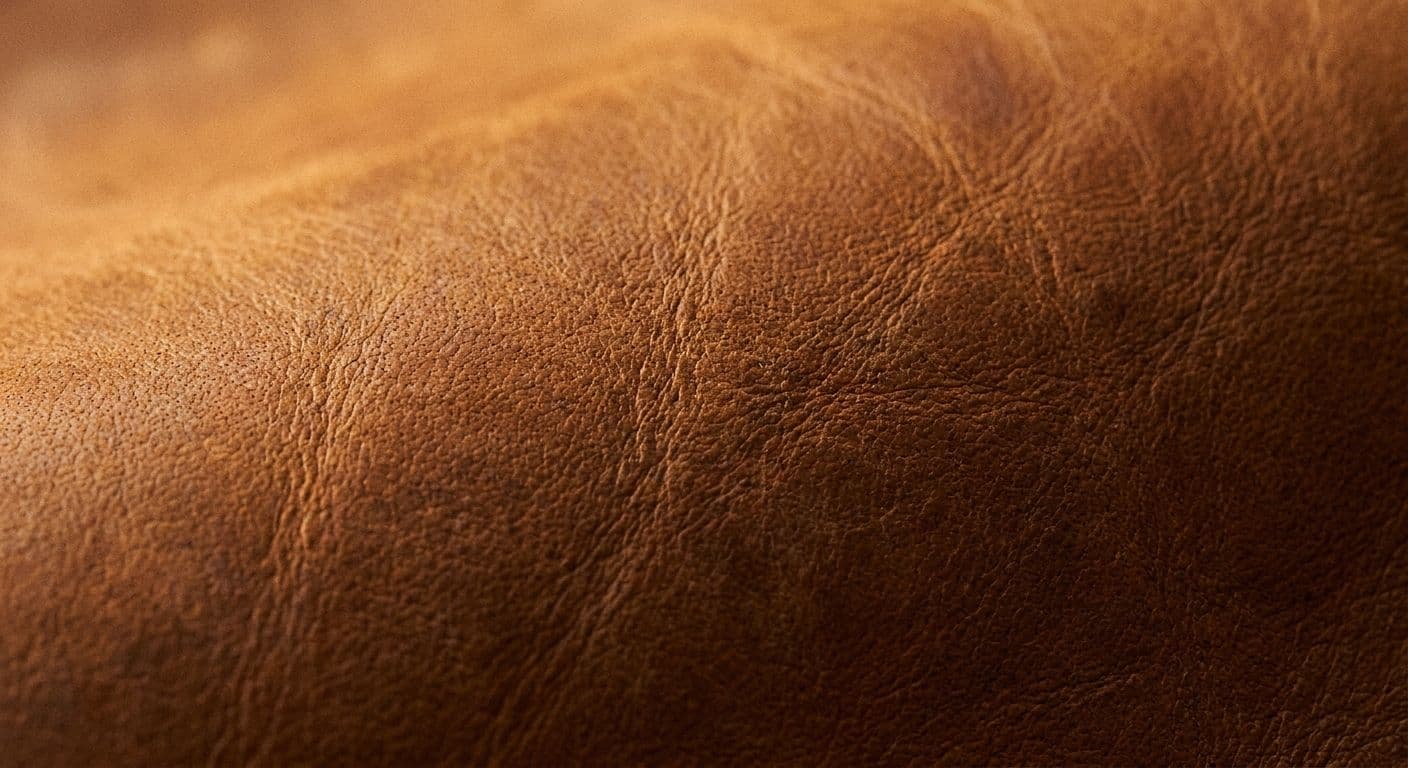
Vegetable-tanned leather: what you need to know before you buy
A vegetable-tanned leather piece can last thirty years. Its chrome-tanned counterpart, produced in a matter of hours, begins to deteriorate far sooner. The difference is invisible to the eye in a shop — it reveals itself over time, and it starts long before the cutting and stitching, in the tanner's vat.
Yet the label "vegetable-tanned" now appears on pieces of wildly uneven quality. Understanding what the process actually involves helps you tell a genuinely living material from a marketing argument.
This guide covers what vegetable tanning really is, why it produces a different leather, how to recognise it, how to care for it — and what to watch for before you buy.
Key takeaways
- Vegetable tanning uses plant extracts (barks, leaves, fruits) to transform raw hide into leather; the process takes several weeks.
- Patina is the signature of this leather: it darkens, develops a lustre, and takes on the imprint of its owner over time.
- Density is higher than chrome-tanned leather: vegetable-tanned leather is firmer at purchase and softens with use.
- The grain (natural surface) is intact on full-grain vegetable-tanned leather — that is where the strength of the fibre lies.
- Care is simple: a dry cloth, a colourless nourishing leather conditioner without silicone, and storage away from direct sunlight.
- The price reflects production time: serious vegetable tanning requires several weeks in the vat, versus a few hours for chemical tanning.
- Not all vegetable-tanned leathers are equal: the quality of the raw hide, the animal's origin, and the tanner's skill matter as much as the process itself.
What is vegetable tanning?
Vegetable tanning is a process that transforms raw animal hide into leather using natural tannin-rich extracts — oak bark, chestnut, mimosa, sumac leaves, quebracho pods. These molecules bind to the collagen fibres of the hide and stabilise them, making the material rot-proof, supple, and resilient.
How does the vegetable tanning process work?
The raw hide passes through a series of vats containing tanning solutions of progressively increasing concentration. The process takes anywhere from several weeks to several months depending on the piece and the tanner's tradition. This slowness is not a luxury: it allows the tannins to penetrate uniformly through the full thickness of the hide — hence the characteristic density of vegetable-tanned leather.
Once out of the tannery, the leather is oiled, dried, and broken in. Its natural colour ranges from pale cream to deep caramel depending on the bath formulation.
What is the difference with chrome tanning?
Chrome tanning uses chromium III salts to stabilise collagen in a matter of hours. The result is a leather that is supple straight out of the vat, uniform, water-resistant — and produced at scale at lower cost. It now accounts for the majority of leather produced worldwide.
The decisive difference: chrome-tanned leather does not develop a patina. Its surface remains static, then deteriorates through flaking. Vegetable-tanned leather, by contrast, evolves with use — it memorises gestures, darkens at friction points, and gains in suppleness and sheen over the years.
| Criterion | Vegetable tanning | Chrome tanning |
|---|---|---|
| Process duration | Several weeks | A few hours |
| Initial texture | Firm, dense | Supple immediately |
| Patina with use | Yes — pronounced | No |
| Long-term resistance | Very high | Moderate |
| Environmental impact | Low (natural) | Higher (heavy metals) |
| Price | Higher | More accessible |
Why patina changes everything
Patina is not wear — it is accumulation. The natural oils of the hand, light, friction at contact points: all of this progressively nourishes the fibres of vegetable-tanned leather and alters its appearance. A vegetable-tanned wallet carried for ten years no longer looks like the one that left the workshop — it has become singular.
How does patina form?
The collagen fibres of vegetable-tanned leather absorb fatty substances and react to oxidation. The most-used areas — corners, flap, edges — darken first and develop a natural sheen. This is why choosing full-grain leather over corrected-grain leather matters: the natural surface is intact, the strongest fibres are preserved, and the patina develops more richly.
Can you control the patina?
You can guide it, not really control it. A colourless nourishing conditioner without silicone, applied in a thin coat two to three times a year, slows drying and evens out ageing. Avoid direct sunlight (which creates uneven patches) and standing water (which leaves tide marks). The rest belongs to use.
How to recognise quality vegetable-tanned leather
A good vegetable-tanned leather announces itself through several physical signals, before you even look at a label.
What are the visible signs of quality vegetable-tanned leather?
A well-tanned vegetable leather has a homogeneous edge (the cross-section), with no visible layers or spongy areas: the dye and tannins have penetrated uniformly. The surface — the grain — is smooth without being plastic; it breathes slightly under the fingertip. The smell is vegetal, faintly earthy, never chemical or plastic.
Several things to check:
- The edge: homogeneous, slightly fibrous, no delamination — a sign of full-grain, non-reconstituted hide
- The surface: subtle natural irregularity (skin grain, small marks) — a sign the grain has not been sanded down and coated
- The firmness: vegetable-tanned leather is dense at purchase; immediate great suppleness can indicate chemical treatment
- The smell: vegetal, never chemical
- The reaction to water: a drop slowly absorbed (then disappearing as it dries) is normal — immediate beading or rejection indicates a heavy surface treatment
Should you be wary of labels?
The term "vegetable tanning" carries no regulatory protection. Its presence on a label guarantees neither the quality of the raw hide, nor the tanner's care, nor the absence of chemical finishing treatments. The reliable elements remain traceability (tannery origin, region, tanner's name) and the reputation of the craftsperson who transforms the leather. A serious leather artisan can always name their tannery and describe the material they work with.
Which pieces benefit most from vegetable-tanned leather?
Vegetable tanning expresses its full potential on small objects carried daily — those that accumulate friction, skin oils, and light. That is where patina builds most visibly.
Wallets, card holders, and small leather goods
A vegetable-tanned leather wallet passes through the hands several times a day. The friction of fingers, the pressure of a pocket, the repeated opening of compartments create exactly the right conditions for a deep patina to develop. After a few months of use, contact zones darken, corners take on a shine — the object tells its story. For those looking for a specific example, the Belize is one such small leather piece worth exploring.
Leather card holders follow the same logic: slim, constant, used at every payment, they age quickly and well. A vegetable-tanned card holder that is properly cared for gains in suppleness and character where a treated-leather model ages through flaking.
What about larger pieces?
Leather bags and passport pouches in vegetable-tanned leather evolve too, but more slowly — larger surfaces, less concentrated at the same friction points, develop a more gradual and less contrasted patina. The density of vegetable-tanned leather gives them good long-term resistance to deformation.
How to care for a vegetable-tanned leather object
Caring for vegetable-tanned leather is minimal — and that is precisely what sets this material apart. It does not need to be waterproofed, treated, or waxed constantly.
What are the essential care gestures?
Three rules cover the vast majority of situations:
- Wipe with a soft dry cloth after contact with moisture — do not rub
- Nourish two to three times a year with a colourless conditioner without silicone, in a thin coat, left to absorb before use
- Store in a cotton pouch, away from direct light and heat
What vegetable-tanned leather does not handle well: standing water (tide marks), prolonged sunlight (uneven ageing), overly rich products applied in excess (they soften and darken irreversibly).
Can damaged vegetable-tanned leather be repaired?
A light scratch often disappears under the finger — warmth and gentle pressure are enough to close the fibres. A water stain dries without marks if blotted immediately. Very dry leather recovers with an application of nourishing conditioner. A deep tear or leather cracked through prolonged neglect, however, is beyond everyday care — the piece should be entrusted to the atelier that made it.
What vegetable tanning does not guarantee
A few things worth bearing in mind before buying — not to discourage, but to help you buy with clarity.
- The quality of the raw hide: vegetable-tanned leather can come from a low-quality hide. The tanning process cannot make up for a mediocre raw material.
- The absence of chemical finishing: some vegetable-tanned leathers receive synthetic coatings at the finishing stage that limit or block patina development. If the surface does not react to a drop of water, the finish is probably waterproofing.
- The quality of the assembly: excellent leather on poor stitching will not last. The durability of the finished piece depends as much on the workshop's craft as on the material.
- Price alone: vegetable tanning costs more to produce — but a high price is not a sufficient guarantee. Traceability and the maker's reputation remain the best indicators.
Frequently asked questions
Is vegetable-tanned leather really more durable than ordinary leather?
Yes, under equivalent care conditions. Vegetable tanning produces a dense leather whose fibres, stabilised by natural tannins, resist abrasion and ageing better than most chrome-tanned leathers. An object made with care from good full-grain vegetable-tanned leather can last several decades — where a chemically treated leather begins to flake after a few years of daily use.
How do you tell vegetable-tanned leather from chrome-tanned leather without a label?
Three quick tests: the edge (homogeneous and slightly fibrous on vegetable-tanned, often bluish or greyish on chrome), the smell (vegetal and earthy versus chemical), and the reaction to a drop of water (slowly absorbed on an uncoated vegetable, repelled on chrome). Initial firmness is also a reliable indicator: an untreated vegetable-tanned leather is always denser than a chrome-tanned leather of the same thickness.
Is it better to buy a new or a slightly patinaed vegetable-tanned piece?
Both have their advantages. A new piece lets you build the patina yourself — it will be the exact imprint of your use. A piece already patinaed by a previous owner (vintage or second-hand) shows how the material has aged, which can be reassuring about its long-term behaviour. In either case, check the condition of the stitching and edges before buying.
Can a vegetable-tanned leather object be engraved?
Yes — the density and natural surface of full-grain vegetable-tanned leather make it particularly well suited to engraving. Heat marks the fibres cleanly and durably. This is one of the reasons why personalised engraving — in gold, silver, or natural — is a coherent option on small vegetable-tanned leather objects made to be given as gifts: it integrates into the material rather than simply sitting on top of it.
Vegetable-tanned leather is not a promise of eternity — it is a living material that asks for a minimum of attention and rewards generously those who choose it well. Before buying, look at the edge, ask where the tannery is, check that the maker can name what they work with. The rest, the leather takes care of itself.

FOUNDER & LEATHER ARTISAN
Amandine Simon
Founder of Suki Paris, Amandine crafts every piece by hand in her workshop in the 17th arrondissement.


