Full-grain vs. corrected-grain leather: how to choose, how to tell them apart
Full-grain leather. You see it everywhere — on leather goods websites, in descriptions of bags costing several hundred pounds, in commercial copy. But what does it actually mean? And more to the point: is it always better than corrected-grain leather?
The short answer: no, not automatically. The long answer is this guide. No marketing. Just what each material is, what it does, and why it matters when you buy.
What exactly is full-grain leather?
To understand full-grain leather, you first need to understand the structure of a hide. A raw hide, destined to become leather, is made up of several layers. The uppermost layer — the one that was exposed to the outside — is called the grain. It is the densest, finest, and most tightly structured layer. Below it lies the junction layer, then the split.
Full-grain leather is leather whose grain layer is entirely preserved — neither sanded down nor concealed beneath a heavy finish. The texture you see on the surface is the animal's natural grain. Micro-variations, slight irregularities, fine marks: they are all there, unapologised for. They are proof that the grain is intact.
A direct consequence: full-grain leather is rare. A hide with no flaw significant enough to prevent its use as-is on the surface requires rigorous selection. That is why quality full-grain leather costs more. Not because it is a marketing argument. Because the raw material is less abundant.
Corrected-grain leather (top grain): an acknowledged compromise
Corrected-grain leather — or top grain — starts from the same place: the uppermost layer of the hide. But it undergoes an additional step: sanding. The surface is lightly buffed to erase scars, insect bites, and natural marks. A finish is then applied — often a layer of pigment and lacquer — which gives the surface a uniform, artificial grain.
The result: a visually clean, highly consistent leather that shows none of the material's natural variation. Easier to produce at scale, more forgiving in hide selection. Some major houses use it for precisely engineered bags where uniformity of surface is a design requirement. It is not bad leather. It is a different leather.
The fundamental difference: corrected-grain leather has a finishing layer between you and the material. That layer initially resists surface scratches better, but it does not develop a patina. What you see on the day of purchase is what you will see in five years — only worse.
Full-grain vs corrected-grain: a comparison
Criterion — Full-grain leather — Corrected-grain leather
Grain — Natural, irregular, alive — Artificial, uniform, applied
Patina — Yes, progressive and unique — No, static surface
Long-term durability — Very good with proper care — Finish wears and peels over time
Immediate scratch resistance — Sensitive (marks, then absorbs into patina) — More resistant initially
Care — Regular conditioning required — Minimal upkeep
Price — Higher (strict hide selection) — Lower at equivalent quality
Ideal for — Pieces meant to age beautifully, sought-after patina — Pieces requiring a stable appearance, very intensive use
How to recognise full-grain leather by touch
There are three simple tests, no instruments required.
The grain. Run your finger across the surface. Full-grain leather has a slightly irregular texture under the finger — some areas smoother, others more textured. If the surface feels perfectly uniform throughout, that is the first sign of an applied finish.
The warmth. Rest your palm on the leather for a few seconds. Full-grain leather absorbs the warmth of your hand almost immediately — the leather warms with you. Leather with a heavy finish stays cooler, with a more plastic feel.
The fold. Gently pinch the leather between two fingers. On full-grain leather, the creased surface shows fine, even micro-wrinkles that disappear when released. On a heavily finished corrected-grain leather, the surface tends to form more pronounced creases or to show micro-cracks in the finish.
These tests are not infallible — a very skilled tanner can produce a corrected-grain leather whose finish is so fine it resembles full-grain. But in 90% of cases, these three gestures are enough.
Why Suki chooses vegetable-tanned full-grain leather
At Suki, all our leathers are full-grain and vegetable-tanned. We source from Italy — one of the few tanning regions that still upholds a full vegetable-tanning process, with methods that take six to eight weeks rather than twenty-four hours.
This choice is not marketing. It is a direct consequence of what we want to make: objects that age alongside you. A vegetable-tanned full-grain leather develops a unique patina — your patina. The way you carry the bag, the spots you touch most, the light it is exposed to: all of this is written into the material. In ten years, your bag will be different from the bag of someone who bought the same style on the same day.
Full-grain leather has one real drawback: it is more sensitive in the early weeks. A scratch leaves a mark. A stain can set. But with minimal care — monthly conditioning, proper storage — these marks become something other than flaws. They become the story of the object.
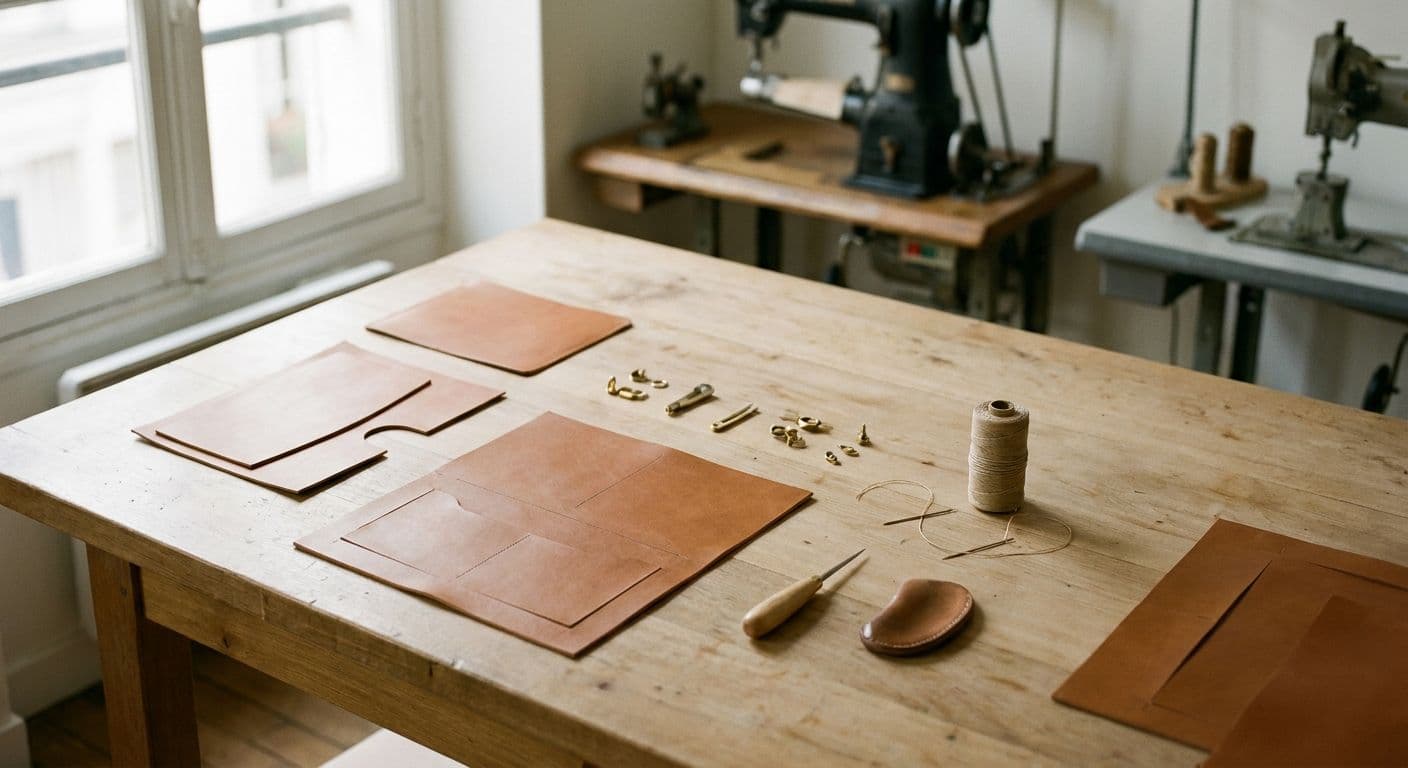
Our vegetable-tanned full-grain leather styles: the Altaï, the Ulysse, the Pandora — each crafted at our atelier on rue Labie, in the 17th arrondissement.
Leathers that are neither full-grain nor corrected-grain (not to be confused)
A few categories worth knowing, so as not to be misled by terminology.
Split leather. This is what remains after the grain has been separated from the hide. The split has neither the density nor the resilience of the grain layer. It is often coated with a synthetic finish and sold simply as "leather" with no further specification. Technically accurate. Substantially different.
Bonded leather. Ground leather fibres glued with latex onto a textile backing. Legally permitted to be called leather in certain countries. In practice: it pills, it crumbles, it does not age — it falls apart.
Faux leather. Generally PU or PVC. No connection to animal leather. The mention "synthetic leather" or "faux leather" should appear on the label. It does not always.
The simple rule: if a brand does not specify "full-grain" or "full grain", it is probably not full-grain leather. Good tanners and craftspeople display this information clearly, because it is a genuine argument, not a constraint.
QUESTIONS FRÉQUENTES
Tout ce que vous voulez savoir

FOUNDER & LEATHER ARTISAN
Amandine Simon
Founder of Suki Paris, Amandine crafts every piece by hand in her workshop in the 17th arrondissement.
IN THE SHOP