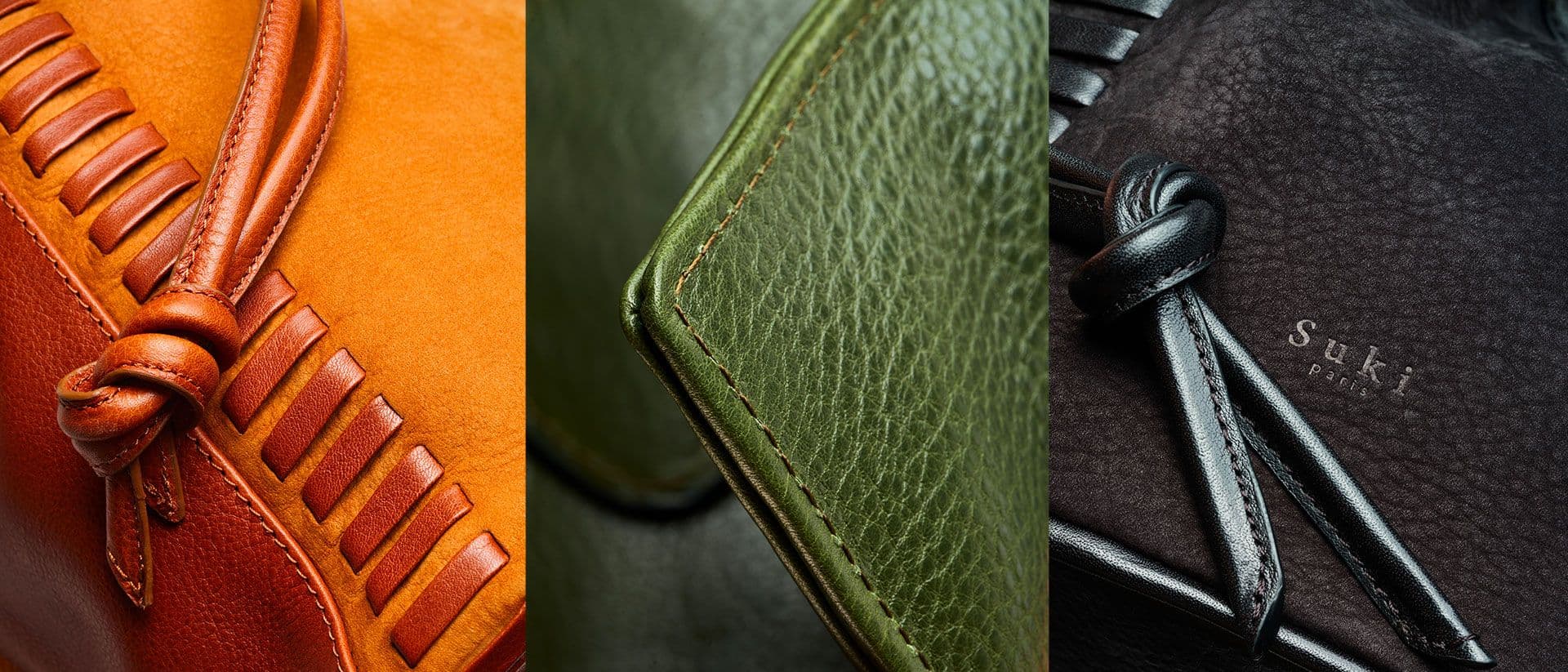
How to Tell Quality Leather Apart: 5 Simple Tests
A good piece of leather reveals itself in seconds — provided you know what to look for. Yet between full-grain, corrected-grain and faux leather, labels look alike and prices swing from one end to the other.
Many buyers walk away with something that will age badly: a surface that flakes after two years, a persistent chemical smell, a glued edge instead of a dyed one. The problem isn't budget — it's the lack of simple visual and tactile benchmarks.
Here are five concrete tests — grain, edge, smell, flex, patina — to assess leather quality in under a minute, before any purchase.
Key takeaways
- Irregular grain is a quality marker: a surface that looks too uniform signals corrected leather or faux material.
- The edge of full-grain leather is dyed and smooth; a glued or cardboard-like edge points to reconstituted leather.
- Smell is reliable: a natural, earthy or faintly animal scent is a good sign; a plastic or chemical smell is an immediate red flag.
- Flex test: press lightly with your thumb — full-grain leather springs back without a lasting mark.
- Patina — the way colour deepens and brightens with use — belongs exclusively to vegetable-tanned leathers; others age, they do not patina.
- Vegetable tanning (hides treated with bark and plant extracts) produces the most durable leathers, the ones most likely to develop their own character over time.
- Price alone is not a guide: an expensive item can contain corrected leather; a small-batch craftsperson can offer full-grain at a fair price.
Grain — the first visual indicator
The grain of natural leather is irregular, alive, unique to each hide. It is the first thing to examine with the naked eye, before you even touch the piece.
How to read a leather surface
Full-grain leather keeps its original surface — with slight texture variations, micro-pores, zones that are denser or more open depending on which part of the hide was used. Run your palm across it: the warmth of your hand leaves a faint, fleeting impression that disappears within a few seconds.
Corrected-grain leather has been sanded and coated with a synthetic finish to mask imperfections. Its surface is too even, almost printed. You can test this by flexing the piece gently: the coating develops hairline cracks at the fold.
Faux leather (PU or PVC) shows a perfectly repeated embossed grain — a stamped pattern with no variation from one area to the next.
| Leather type | Grain | Reaction when flexed |
|---|---|---|
| Full-grain | Irregular, natural | Faint mark, disappears quickly |
| Corrected-grain | Uniform, coated | Hairline cracks visible |
| Faux (PU/PVC) | Regular repeated pattern | Frank, rapid cracking |
For a deeper look at these differences, the guide full-grain vs corrected-grain leather covers the implications for lifespan and care.
The edge — what construction really looks like
The edge — the cut side of the leather visible along the border of a card holder or passport sleeve — says a great deal about how a piece was made.
What does a good leather edge look like?
On well-finished full-grain leather, the edge is hand-dyed, smooth to the touch and slightly rounded. It forms a continuous, homogeneous surface, sometimes with a subtle sheen. This is called a burnished edge or raw edge finish.
On reconstituted leather (or leather glued onto a textile backing), the edge exposes the layers: with the naked eye you can see a greyish or fibrous core covered by a thin surface film. With use, those layers separate. On quality leather card holders, a hand-dyed burnished edge is one of the most telling signs of craftsmanship.
How to test the edge in a shop
Run your thumbnail perpendicular to the edge: on well-finished full-grain leather you feel even, consistent resistance. On glued leather you risk lifting a micro-layer. Also check whether the edge shows bubbles or uneven glue lines — a sign of a fast industrial finish.
Smell — an underrated test
Smell is one of the most reliable ways to tell natural leather from a synthetic substitute — and it requires no tools whatsoever.
What can the smell of leather tell you?
Vegetable-tanned leather has a warm, slightly earthy or faintly animal scent, sometimes with woody notes depending on the plant extracts used in the tannery. It is a smell that softens with time and never turns harsh. Chrome-tanned leather smells more neutral, faintly metallic or chemical. Faux leather smells of plastic — often masked at manufacture by an added fragrance that fades within weeks.
Vegetable tanning, used in French artisan leatherwork, produces hides whose smell stays pleasant for years and evolves alongside the patina.
Flex and recovery
Good full-grain leather of adequate thickness is supple without being limp, and returns to shape after compression. This behaviour comes from the intact fibre structure of the hide.
How to test leather flexibility
Pinch a small area lightly between thumb and forefinger, then release. On full-grain leather the surface returns to its original position in under a second, with a faint mark that fades immediately. On coated or corrected leather the mark is sharper and lasts longer, because the surface coating stiffens the hide. On thick faux leather, the deformation can be permanent.
Also try a full fold: bend the piece in half (where the shape allows). Supple full-grain leather resists without cracking. Leather glued onto a rigid backing creaks or feels abnormally stiff.
Thickness and weight as indicators
A small article in full-grain leather is noticeably heavier than a similar piece in faux leather. A leather coin purse weighing around thirty grams when empty reflects real hide thickness. A very light piece for its size is often a sign of a textile backing covered with a thin leather or synthetic film. For those looking for a compact everyday option, the Belize is one example of a small leather accessory worth considering.
Patina — the ultimate proof of vegetable tanning
Patina is the natural deepening and brightening of a leather's colour and sheen through use and friction. It is the most telling durability criterion — and the only one that is confirmed over time.
Which leathers develop a patina?
Only vegetable-tanned leathers — treated with bark, leaf or fruit extracts — develop a true patina. The hide's natural fats, combined with plant tannins, react to heat, light and contact to gradually darken and acquire a sheen. This transformation is irreversible and unique to each piece.
Chrome-tanned leathers (mineral tanning, dominant in industrial production) do not patina: they age uniformly and tend to fade or crack. Faux leathers flake or craze. For more on caring for a piece that patinas, see the guide how to care for a leather bag.
How to spot at purchase a leather that will patina
Ask directly whether the leather is vegetable-tanned — a serious seller or craftsperson can answer immediately. On an honest product page, the mention of "vegetable tanning" or "full-grain cow leather" is explicit. The complete absence of any mention of tanning method should raise a flag.
New vegetable-tanned leather often has a slightly matte, subtly uneven tone across the hide. That initial irregularity is a feature, not a flaw: it is precisely what guarantees a rich, personal patina after a few months of regular use. Leather types and how they behave over time are covered in a dedicated guide.
Frequently asked questions
How can I tell if leather is genuine without a label?
Three quick tests with no label: smell (earthy or faintly animal = good sign; plastic = faux), the edge (even and dyed = full-grain; visible layers = reconstituted), and — on a sample only, never on a finished item — a flame held to a scrap of the edge: real leather burns slowly with a smell like singed hair; faux leather melts or ignites quickly with black smoke.
Is full-grain leather always more expensive?
Not necessarily. A mass-produced full-grain article can cost less than a corrected-grain piece from a major brand with high distribution costs. Price reflects the label as much as the material. That said, at an equivalent price point, a craftsperson will almost always offer superior hide quality compared to a mass-market retailer — because their model depends on durability, not rapid renewal.
Can you judge leather quality by its colour?
Colour alone is not enough, but there are clues. Full-grain leather in a natural shade shows slight variation — lighter zones towards the edges, subtle tonal shifts between parts of the hide. A perfectly uniform colour across the entire surface often indicates a thick coating, typical of corrected leathers. Very vivid, heavily saturated colours on smooth leather are frequently associated with film-forming finishes that mask the real surface.
How do you care for quality leather to preserve its patina?
Vegetable-tanned leather is straightforward to maintain: a soft dry cloth for dust, a silicone-free colourless nourishing cream applied in a thin layer two or three times a year, and storage away from direct light — ideally in a cotton pouch. Avoid heavy wax products that clog the pores and block the natural patina. Prolonged heat and moisture are the only real enemies of a beautiful piece of full-grain leather.

FOUNDER & LEATHER ARTISAN
Amandine Simon
Founder of Suki Paris, Amandine crafts every piece by hand in her workshop in the 17th arrondissement.


