Caring for a Leather Bag: Every Gesture That Makes It Last
Caring for a leather bag is less complicated than most people think — and far more decisive than they realise. Neglected leather dries out, cracks, and loses its lustre within a few seasons. Leather that is tended to regularly lasts for decades and develops a patina that no other material can replicate.
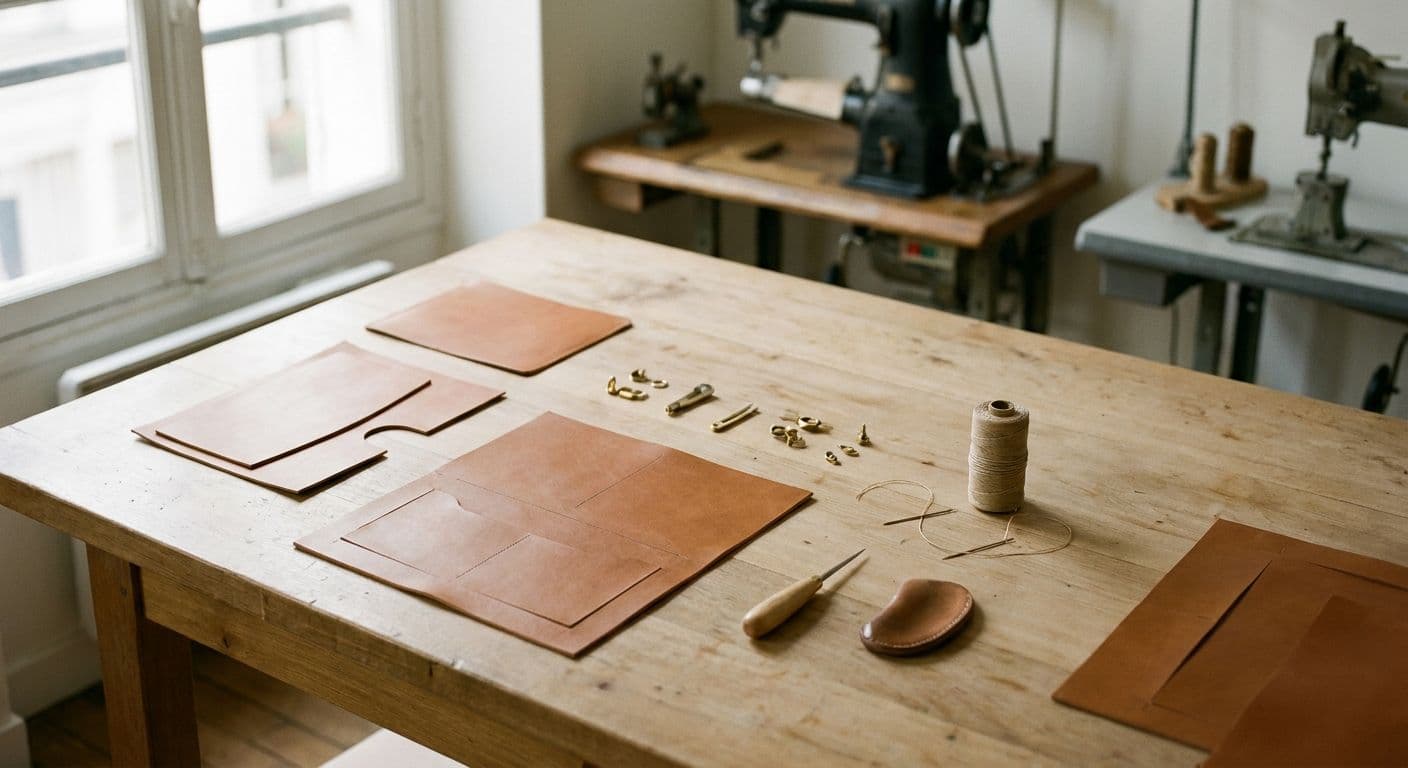
At Suki, we work with full-grain vegetable-tanned leather sourced in Italy, from our workshop on rue Labie in the 17th arrondissement. This guide brings together everything we share with our customers: everyday habits, occasional treatments, and the specifics of vegetable-tanned leather for those who carry our pieces.
No miracle products. Just the right gestures.
Why a leather bag deserves regular care
Leather is a living material. It breathes, absorbs ambient moisture, and reacts to heat and light. Unlike synthetic materials, it does not age passively — it evolves according to how it is looked after.
A well-maintained leather bag is an investment that stands the test of time. One that is left untreated, even if of good quality, can crack within two or three seasons. The difference comes down to a few simple gestures, repeated consistently. Prevention costs infinitely less than repair.
Everyday habits for caring for a leather bag
Caring for a leather bag begins before any product is applied. It is daily habits that make the difference over time.
- Avoid prolonged exposure to sunlight — direct light degrades the fibres and fades the colour. A wardrobe or a shaded shelf is ideal when the bag is not in use.
- Do not overfill — an overstuffed bag strains the seams, distorts the structure, and stretches the leather at stress points. Remove anything unnecessary.
- Remove sharp or pointed objects — keys, pens, scissors: they scratch the lining and can pierce the leather from the inside.
- Store in its cotton dust bag — every Suki piece comes with a dust bag. It protects against friction and dust, and unlike plastic, allows the leather to breathe.
- Be careful with unfixed dark textiles — raw denim and dark navy or black knits can transfer dye onto light-coloured leather (camel, natural). Once the dye is absorbed, it is irreversible.
How to moisturise leather: creams, balms, and frequency
This is the single most important step in caring for a leather bag. Simple, quick, and decisive over time.
Which product to choose
A colourless nourishing lotion free of silicone. Formulas based on beeswax or lanolin are the most respectful of the fibres. A finishing wax balm can complement this for areas prone to wear (corners, handles). Avoid products with artificial shine agents: they block the pores, prevent patina development, and age poorly.
We use a plain natural beeswax. No brand endorsement — simply what works on our leathers.
How to apply
Take a soft, clean cotton cloth — an old shirt works perfectly well. Apply a small amount of lotion to the cloth (never directly onto the leather). Work in circular motions across the entire surface, paying particular attention to areas that dry out first: corners, edges, fold lines, and handles.
Leave to absorb for ten minutes, then wipe away any excess with a clean cloth. A soft-bristle brush can revive the grain if you wish to restore a little structure.
The golden rule: a thin layer is always better than a thick one. Too much product becomes tacky, attracts dust, and clogs the pores.
How often
Twice a year for regular use, three to four times for a bag carried daily. And always after exposure to water or harsh conditions. Leather that is beginning to look matt or slightly dull is telling you it is thirsty. Always apply sparingly: too much product clogs the pores and blocks the patina.
How to clean a stained leather bag
First of all: do not panic. Most stains do not damage the leather in depth. Some fade on their own over time, absorbed into the patina. Others call for prompt attention.
Grease or oil stain
Blot the excess immediately with a dry cloth — do not rub. Sprinkle cornstarch, talcum powder, or fuller's earth over the stain and leave to work for several hours (overnight if possible). The powder absorbs the grease. Brush off gently, and repeat if necessary. In most cases, the stain fades considerably.
Water stain or tidemark
Counter-intuitive but effective: lightly dampen the entire surface of the bag with a cloth that is either just damp or lightly moistened with lemon juice. The leather absorbs the water evenly, and the ring disappears as it dries. Leave to air-dry, away from any heat source. Then feed the leather.
Ink stain
The most difficult to treat. Ink penetrates the fibres quickly. A gentle magic eraser can reduce fresh marks. Specialist ink removers may help, but rarely eliminate the stain entirely. Over time, the patina absorbs the mark into its grain. Accept it — it is a story your bag is telling.
What to do if your leather bag has been caught in the rain
Water is not the enemy of leather. What causes damage is dry leather suddenly exposed to moisture: the fibres absorb water unevenly, creating tidemarks and stiffness as it dries.
If your bag has been caught in the rain: blot the excess water with a clean, dry cloth. Lightly stuff the bag with tissue paper to help it retain its shape. Leave to dry at room temperature — never near a radiator, never with a hair dryer, never in direct sunlight. Once dry (12 to 24 hours), nourish.
Leather that is regularly moisturised will absorb a light shower without leaving a mark. Preventive hydration is your best protection.
Vegetable-tanned leather: specific care
Vegetable-tanned leather is the material we use at Suki — sourced from committed European tanneries, worked from our workshop on rue Labie. It is the finest available, and it requires a few additional precautions.
Vegetable tanning uses natural tannins extracted from tree bark — oak, mimosa, chestnut. The process takes six weeks, compared with twenty-four hours for chrome tanning. This slowness gives the leather a density, a breathability, and a capacity to develop patina that chrome simply cannot achieve.
For this type of leather specifically:
- No silicone, no artificial shine agents — they close the pores and block the natural patina, which is precisely what makes vegetable-tanned leather so beautiful.
- Air drying only — heat forces rapid drying and permanently stiffens the fibres.
- Patina is the goal — the darker areas where you hold the bag, the soft sheen on the corners: that is the leather living. Do not wipe it away.
A vegetable-tanned leather bag cared for over two years is more beautiful than a new one. It has absorbed the light of hundreds of days, and taken the shape of your hand. There is a Japanese word for this — wabi-sabi: perfection in imperfection, beauty in the passage of time.
How to store a leather bag between uses
Storage is often overlooked. Yet it is where the bag spends the greater part of its life.
- In its cotton dust bag — protects against dust, allows the leather to breathe. Never in sealed plastic.
- Never folded — a bag stored folded will keep the fold. Slip tissue paper inside to preserve the shape.
- In the shade — a wardrobe, a shelf. Not on a sun-drenched windowsill.
- Without direct contact between pieces — separate bags with tissue paper to prevent dye migration.
Mistakes to avoid that damage leather
A few habits to abandon for good:
- Drying with heat — radiator, hair dryer, direct sunlight: the leather stiffens, cracks, and loses its natural oils.
- Cleaning with household products — alcohol, vinegar, detergent: they strip the leather and destroy the finish.
- Storing in airtight plastic — the leather suffocates and may develop mould in humid conditions.
- Applying too much product — a thin layer that is absorbed is always better than a thick layer that sits on the surface and attracts dust.
- Rubbing a fresh stain — rubbing spreads and drives the stain deeper. Always blot and dab — never rub.
To learn more about how we work with leather, read what a day in our workshop on rue Labie looks like. You will understand why we choose this material, and no other.
QUESTIONS FRÉQUENTES
Tout ce que vous voulez savoir

FOUNDER & LEATHER ARTISAN
Amandine Simon
Founder of Suki Paris, Amandine crafts every piece by hand in her workshop in the 17th arrondissement.
IN THE SHOP