Made in Paris or Made in France: What It Really Changes
"Made in France." Three words appearing on more and more bags and accessories. Three words that do not all mean the same thing.
Choosing a piece of French leatherwork made in a single Paris workshop changes traceability, price and how long the bag lasts.
This is not a question of bad faith. It is simply that between what the law requires to affix this label and what consumers imagine when they read it, there is a gap worth understanding.
Made in France, Made in Paris: Two Labels, One Big Difference
In France, European customs regulations determine a product's origin based on the country where the "last substantial transformation" took place. In practice, for a bag, this means the main assembly operation.
A bag may legally be stamped "Made in France" if its final assembly takes place in France — even if the leather comes from Asia, the hardware from a third country, and the cutting from a workshop in Eastern Europe.
This is not fraud. It is the rule. The same rule applies across the entire European Union, and it reflects a commercial and customs logic that was never designed to protect the fine leather goods consumer — it was designed to price international trade.
French leather goods: the specific case of leather and manufacture
The leather goods industry is a structured sector where the reality of manufacture is often more complex than the label suggests.
Two labels must be distinguished, which brands sometimes use interchangeably:
"Confectionné en France" (Made up in France) — stitching and assembly took place in France. Cutting, preparation, and materials may come from elsewhere.
"Fabriqué en France" (Manufactured in France) — a broader interpretation, often used when the entire production process (or the majority of its added value) is carried out in France. There is no precise legal threshold attached to this wording.
The "Entreprise du Patrimoine Vivant" (EPV) certification and sector labels such as "Cuir à Paris" offer stronger guarantees — they require independent verification of craftsmanship and production conditions. But these certifications remain voluntary.
Why brands rarely say where they manufacture
Transparency about the supply chain remains largely voluntary in the fashion and luxury industry. The European due diligence directive (adopted in 2024) imposes traceability obligations on large companies — not on SMEs.
Most mid-to-upper-end leather goods brands do not communicate the country of origin of their leathers, the identity of their subcontractors, or the geographical breakdown of their operations.
This silence is not necessarily a lie. It is often a commercial policy: supply chains are complex, ever-changing, and detailing them publicly exposes a brand to criticism if anything shifts. For many, ambiguity is more comfortable than transparency.
Why we say "Made in Paris" and not "Made in France"
At Suki, we do not say "Made in France" because, in the context described above, that phrase does not say precisely enough what we actually do.
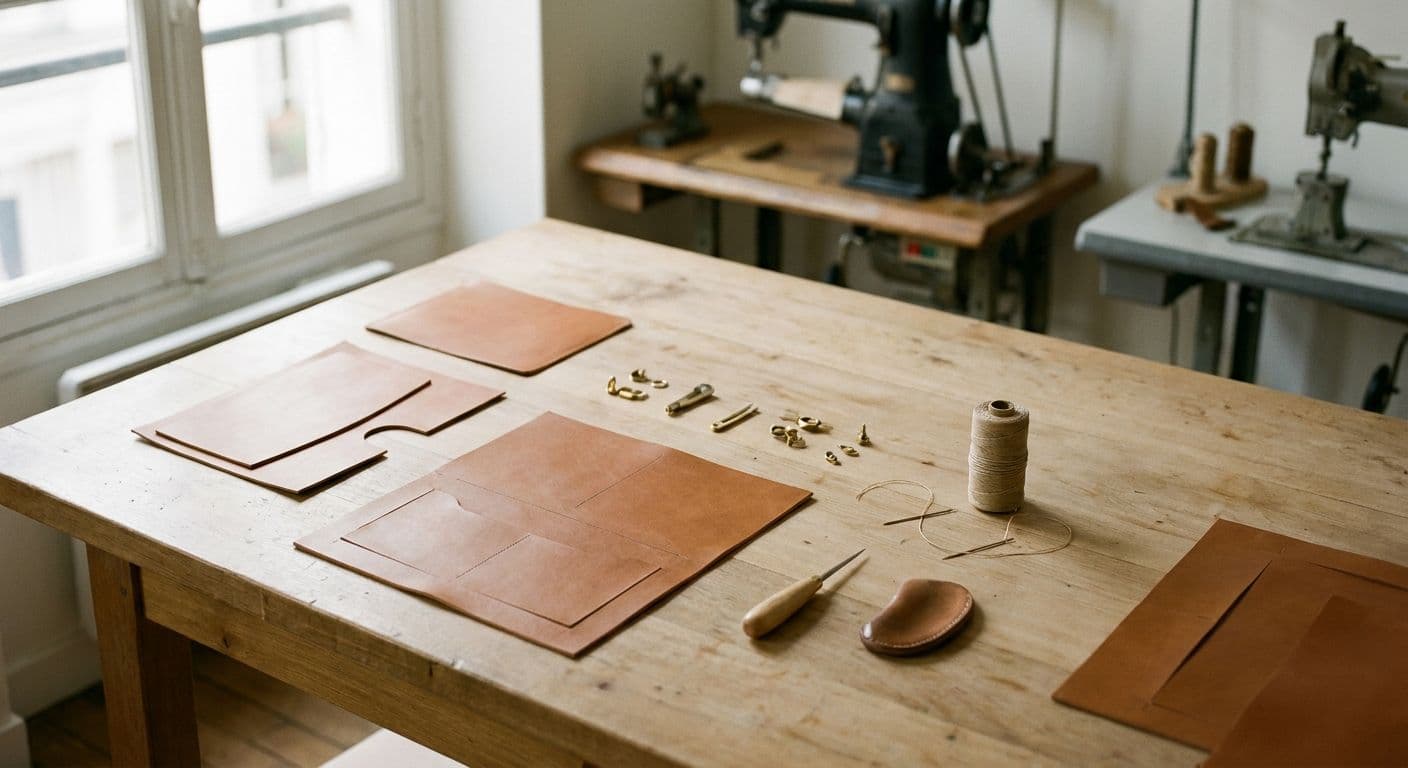
What we actually do: every piece is cut, prepared, sewn, assembled, and finished in our workshop at 6 rue Labie, in the 17th arrondissement of Paris. By hands we know. In a space we occupy every day.
The leathers come from Italy — we select them directly from our tanners, not through an intermediary. The hardware comes from Europe. There is no subcontracting of cutting or assembly.
"Made in Paris" says that more honestly than "Made in France". It gives a precise address. Not a country. A street.
5 questions to ask your favourite brand
Whether you buy from us or elsewhere, these five questions deserve a clear answer before spending €200, €400 or €800 on a "Made in France" bag:
1. Where is the leather tanned? Tanning is the most decisive operation for final quality. A vegetable-tanned leather from France or Italy is not the same as a chrome-tanned leather imported from Asia and assembled in France.
2. Where is the cutting done? Cutting may take place in a different workshop from assembly. That is not a problem in itself — but it is worth knowing.
3. Is any assembly subcontracted? A brand may assemble its pieces in a third-party workshop located in France — which still qualifies as "Made in France" — without the craftspeople being employed or trained by the brand itself.
4. How long does it take to make a piece? Production time is an indicator of the quality of the craft — and a brand that truly makes things by hand can quantify it.
5. Can we visit the workshop? The answer to this question says a great deal about the level of confidence a brand has in its own production conditions.
Our commitment: 100% atelier rue Labie
For each of these five questions, here are our answers:
The leather is selected from committed European tanners we visit. Cutting, splitting, assembly, hand stitching, finishing, and quality control are all carried out at 6 rue Labie, Paris 17e. There is no subcontracting of manufacturing operations. A piece takes an average of 8 hours to make. The workshop is open for visits by appointment — contact us.
We are not saying this to score points against competitors. We are saying it because this is information you deserve to have before buying an object you will carry for ten years.
To understand what this produces in concrete terms — a piece that lasts, that develops a patina, that is worth caring for — read our vegetable-tanned leather care guide. And if you want to see what happens on the making side, 24 hours in our workshop is made for that.
QUESTIONS FRÉQUENTES
Tout ce que vous voulez savoir

FOUNDER & LEATHER ARTISAN
Amandine Simon
Founder of Suki Paris, Amandine crafts every piece by hand in her workshop in the 17th arrondissement.
IN THE SHOP