Hand-Braided Leather — 47 Metres, 400 Gestures, a Day in the Workshop
There are gestures in a leather workshop that can be hurried along. Cutting, once you know the hide well. Hot-stamping, when the temperature is right. Hand stitching, along a long straight line.
Leather braiding cannot. Leather braiding refuses to be rushed. It is one of the rare gestures at the rue Labie atelier that pushes back, that asks you to stop, to look, to undo. And that is precisely what makes it the recognisable hallmark of a well-made piece.
Metres of leather
Before the first braiding gesture on the Altaï, a lengthy preparation begins. Every piece of leather is meticulously traced to define the exact pattern of the braid. Stitch by stitch, each passage of the lace is marked and then pierced by hand or with a punch, creating the path the leather will follow.
This stage demands patience, consistency, and great precision. The slightest misalignment can upset the balance of the finished pattern. Once all the reference points are in place, the leather lace can be gradually interlaced to reveal the motif and bring the characteristic relief of the braid to life.
The beauty of a braided piece therefore lies not only in the gesture that weaves the leather together, but also in all the preparatory work that precedes it. A craft where every detail matters, and where hundreds of gestures contribute to the creation of something singular.
The first crossing
Leather braiding always begins with the same gesture: laying the first strands in a cross, establishing the rhythm. Over, under. Over, under. It is a binary logic, but its complexity lies in tension.
Too loose, and the braid gapes and loses its shape at the first use. Too tight, and the leather marks, the internal fibres break, and the lace eventually splits. The saddler's hand seeks the point of balance — the one that will remain identical from the first crossing to the four-hundredth. That consistency is something no machine has ever truly replicated.
Hand braiding vs machine braiding — why we don't cut corners
Braiding machines exist. They are precise, fast, and consistent. We do not use them.
For a simple and tactile reason: a machine braids at a fixed tension. Leather is not. A hide has denser zones (the back, the flank) and more supple ones (the edges). By hand, we adjust tension at every crossing according to the area we are working through. By machine, the tension is uniform throughout — and what the leather was trying to say is lost.
Hand braiding also means accepting that no two pieces will ever be identical. On a Suki braided handle, no two strands will have exactly the same grain — and that is precisely what distinguishes a living piece from a copy.
Why only vegetable-tanned leather can be braided
Leather braiding does not work on just any hide. A chrome-tanned leather — supple, saturated with moisture, elastic — tears under the repeated tension of the crossings. The edges fray, the lace stretches and becomes uneven the moment it is put under stress.
Vegetable-tanned leather — the kind we use in the atelier — is dense, structured, almost dry to the touch. It cuts cleanly, it does not fray, it holds its shape under tension. It is the only leather that can withstand being handled four hundred times without losing its integrity. It is also the only one that will develop a true patina over the years.
An entire day for a single piece
Creating a braided piece involves many stages and several hours of skilled work. It begins with cutting the leather, followed by extensive bench work: tracing, preparing the elements, marking and piercing the points that will receive the braid.
Then come skiving, gluing, and edge-turning, which refine the leather's edges and achieve clean, lasting finishes. The braiding can then begin. Lace by lace, the leather is interwoven by hand to gradually reveal the distinctive pattern and relief of the piece.
Once the braiding is complete, the various elements are assembled by machine stitching. The metal hardware is then fitted with care, before the final step: hand-dyeing the edges — the signature of an elegant and considered finish.
From the first cut to the last touch of dye, each creation calls upon hundreds of gestures and an exacting craft, where patience and precision are the guarantors of the final quality.
The leather speaks — when a strand resists
During braiding, it sometimes happens that a strand resists. It refuses to pass through cleanly, it catches, it twists. This is a sign that a mistake was made earlier — a few rows back.
You do not force it. Forcing the leather always means losing. You stop. You look at the previous crossing, and the one before that. You find the error — often tiny, a half-lace misplaced, a tension pulled too tight two rows earlier.
Leather braiding teaches something you cannot learn anywhere else: that going back is not a defeat. It is the condition of the right gesture.
Suki's braided leather styles
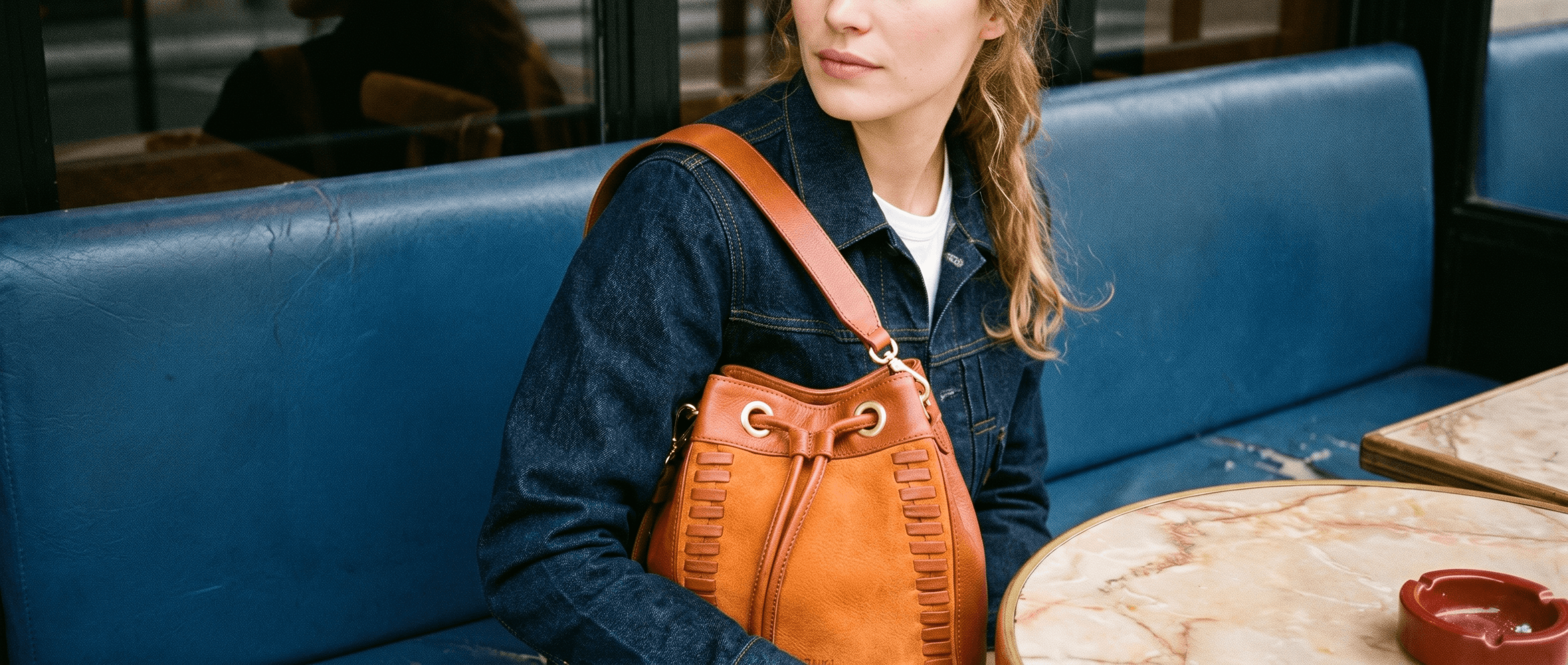
The Altaï bucket bag celebrates the art of braiding through its carefully crafted details. Each leather interlacing is worked by hand, lending the piece relief, character, and depth. This meticulous work gives the bag its singular identity while revealing the natural beauty of the full-grain leather.
Recognising an authentic braided leather piece
A few details allow you to distinguish handmade leather braiding from an industrial one. The tension is never perfectly even along its full length — it follows the hide. The edges of the laces are neat, slightly rounded by the skiver, never cut bluntly. And above all, the ends are finished by hand: on a hand-braided piece, you can see the linen thread that closes the braid — not a metal crimp.
And then there is the feel, which is the hardest to describe yet the most telling: a hand-braided piece has a variable density under the finger — you can sense where the hide was tighter, where it was more supple. To understand how this texture evolves over time, read how to care for a leather bag — and discover why a well-made piece only gets better with the years.
QUESTIONS FRÉQUENTES
Tout ce que vous voulez savoir

FOUNDER & LEATHER ARTISAN
Amandine Simon
Founder of Suki Paris, Amandine crafts every piece by hand in her workshop in the 17th arrondissement.
IN THE SHOP