How to Wear a Leather Crossbody Bag: 5 Ways
The leather belt bag has long suffered from an unfair reputation. Festivals. Hiking. Nylon beach bags. That is not what we are talking about here.
Worn on the shoulder or crossed over the body, the leather crossbody bag for women works from denim to tailored looks, never at the hip.
What we make at rue Labie is a full-grain vegetable-tanned leather crossbody bag, worn over the shoulder — an accessory that frees your hands without compromising your silhouette. An everyday companion, built to last.
5 Ways to Wear a Leather Crossbody Bag
The trouble with most bags is that they ask something of you. The shoulder bag slips with every movement. The handbag monopolises an entire arm. The backpack forces you to turn around every time you reach for your keys.
The leather crossbody bag solves all of this in a single gesture: strap over the shoulder, piece resting diagonally on the opposite hip. Hands are free. The bag is there, within reach, without a second thought.
This is not a compromise. It is a silhouette choice. The diagonal of the strap visually lengthens the torso. The piece structures an outfit rather than weighing it down.
And when the leather is full-grain, vegetable-tanned — dense, firm, developing a patina with time — the bag ceases to be a functional accessory. It becomes a piece with character.
How to wear a leather crossbody bag with style
The fundamental rule, and it is non-negotiable: the bag is worn crossbody over the shoulder, never at the waist. This is a design choice — wearing it at the hip erases the silhouette and is too reminiscent of the festival bag of the 1990s.
The correct way to wear it: strap over the left or right shoulder, the piece resting on the opposite hip, in a natural diagonal across the torso. This is what is known as the crossbody carry.
Height: the piece should rest at the top of the hip. Too high (at bust level), it looks utilitarian. Too low (at knee level), it veers towards festival territory.
Strap adjustment: the adjustable strap is there to be adjusted. Take five minutes to find your length. That is the difference between a bag you carry and a bag you forget you are wearing.
What to wear it with: a trench coat, a summer dress, a blazer, jeans — the leather crossbody bag adapts to everything. That is precisely what sets it apart from a sports bag.
How to choose your leather crossbody bag: size, colour, fastening
It all depends on what you carry day to day.
A compact leather belt bag holds the bare essentials: phone, card, keys, lip balm. For light outings, days without a heavy agenda.
A mid-size format also fits a slim wallet, a notebook, all the daily essentials. This is the bag you pick up in the morning and never set down.
A larger format goes further: a separate front pocket, structured space for travelling light or spending a night away without changing bags.
Camel: develops a patina quickly and spectacularly. Darkens at contact points, acquiring a natural sheen. The most lively colour.
Black: understated, goes with everything, remains discreet even after years of wear. The most versatile colour.
Tobacco: between the two. Warm without being expressive, ideal if you are undecided.
For the fastening: look for a zip fitted by hand and tested before shipping. A zip that catches on day one will always catch — it is the first point of failure on entry-level belt bags.
Full-grain vegetable-tanned leather: why it changes everything
Not all leather crossbody bags are equal. The difference begins with the material.
Vegetable tanning uses natural tannins — oak and chestnut bark — instead of chromium salts. The process takes longer, several weeks rather than a few days, but the result is incomparable: a firm, dense leather that holds its shape and develops a unique patina with use.
Full grain refers to the top layer of the hide, where the natural grain remains intact. It is the most resistant, the most beautiful, the layer that develops the finest patina. Corrected-grain leathers — sanded and coated — offer a uniform surface but lack soul; they do not age gracefully, they simply deteriorate.
Our leathers come from Italian tanneries selected for their full-grain vegetable-tanning technique. This is not a marketing argument — it is what determines the longevity of the piece.
The shoulder strap deserves particular attention: on a crossbody bag, it bears the full weight. A stitched full-grain leather strap holds. A synthetic or woven strap that loosens — that is usually where cheaper bags begin to fail.
The Suki Paris styles worth discovering
Two leather crossbody bags, all made at the rue Labie workshop (Paris 17th), all in full-grain vegetable-tanned leather. The same exacting craft, two ways to be worn.
The Pandora is the most architectural. Wider, with a separate front pocket that lets you organise your belongings — phone on one side, wallet on the other — without rummaging. This is the bag for long days, overnight trips, situations where everything must be within reach without anything being piled together.
The Ulysse is the everyday model. Structured, it accommodates a wallet, a notebook, all the daily essentials. It is the one you pick up in the morning and do not put down for the rest of the day. Available in black and other colours, with an adjustable shoulder strap.
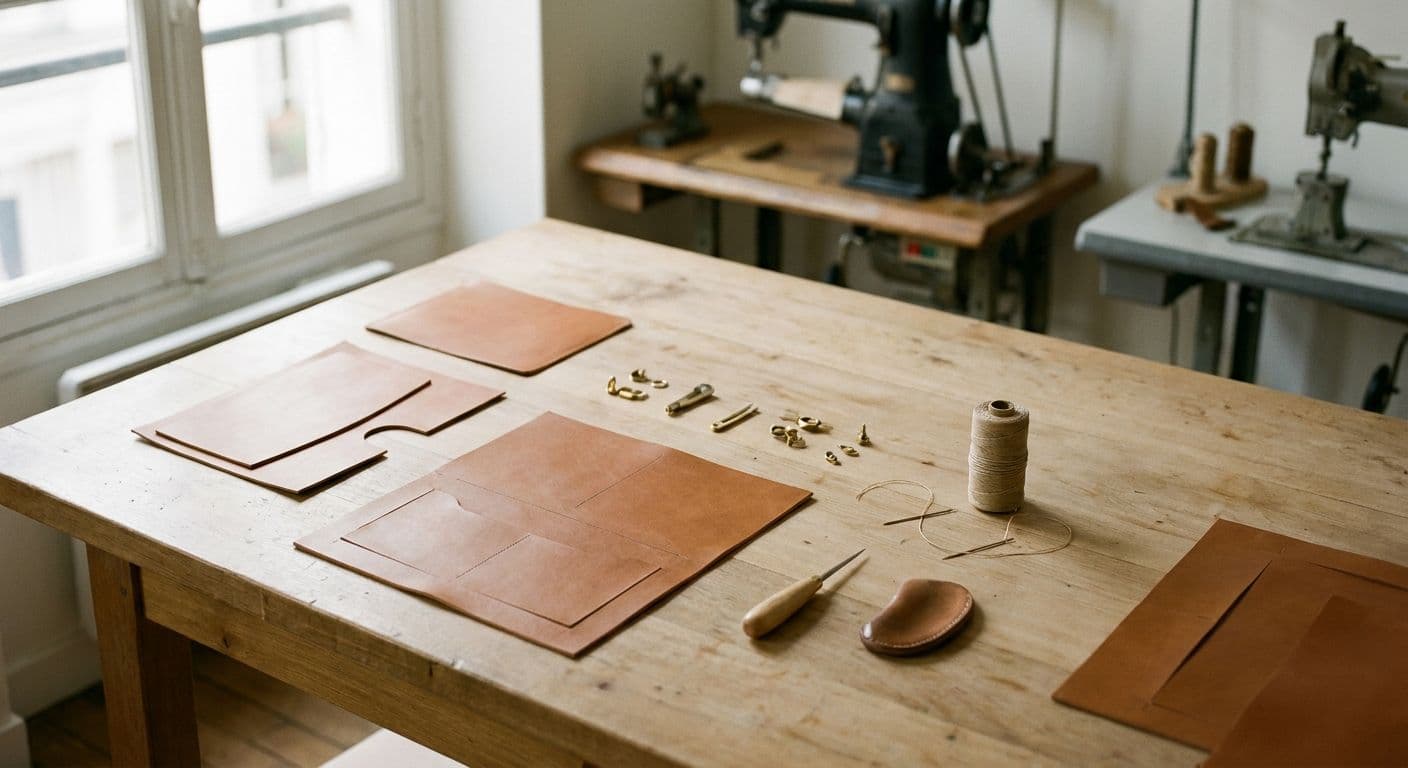
Every piece spends around eight hours in the hands of our craftspeople. Zips are fitted by hand and tested before leaving the workshop.
How to care for your leather crossbody bag so it lasts
A vegetable-tanned leather crossbody bag does not ask much — but it does ask for regularity.
Cleaning: a slightly damp cloth is enough to remove dust or surface marks. Avoid chemical products and excess water. If the piece gets wet, allow it to dry naturally, away from any heat source.
Conditioning: every two to three months, apply a natural conditioning cream (beeswax, lanolin). Vegetable-tanned leather absorbs very well — that is what allows it to develop a patina rather than crack.
Storage: tuck tissue paper inside to maintain the shape if the piece is stored for a long period. Keep it away from direct light, and never in a plastic bag — leather needs to breathe.
Repair: a well-executed hand stitch can be repaired. If a thread breaks, the hand stitching still holds — unlike a machine stitch, which can unravel entirely. The piece can be mended, not simply replaced.
QUESTIONS FRÉQUENTES
Tout ce que vous voulez savoir

FOUNDER & LEATHER ARTISAN
Amandine Simon
Founder of Suki Paris, Amandine crafts every piece by hand in her workshop in the 17th arrondissement.
IN THE SHOP